 Click
here to print
Click
here to print
By Nina Prater [1], NCAT Agriculture Specialist
“When you pass through that gate, get as close to the left post as you can. You’ll feel like you’re gonna tip, but you won’t.”
Those were the comforting instructions my husband Jeremy gave me during our recent tractor-driving lesson. We have been farming together for 18 years, raising a variety of livestock on his family’s farm in the Ozark Mountains of Arkansas. We are keeping the operation simple these days—he and I have a small herd of meat goats, and my father-in-law has a small herd of cattle.
In all these years, I’ve only ever driven the tractor one time. With back wheels almost as tall as I am, I found the tractor intimidating. During the pandemic we talked about how I should learn how in case everyone else got sick and I needed to feed the cows their hay, but we never got around to doing anything about it. With our two children to keep up with, we somehow found ourselves falling into heteronormative gender roles without meaning to.
But on a sunny, breezy afternoon this February when I joined him to do chores (mainly so I could ogle the new baby goats) he asked, “Do you want to drive?” And without hemming and hawing, I said, “Sure!”
I think because we hadn’t planned this tractor lesson ahead of time, I didn’t have time to worry or put up any mental barriers that might have held me back. I just said a quick yes and suddenly I was in the driver’s seat learning the gears, which levers did what, and how to operate the front hay spike and the back haybale unroller attachment.
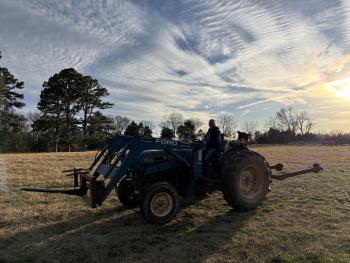
The author during her first lesson on a tractor with hay-feeding attachments on the front and back. Photo: Jeremy Prater
Jeremy is a patient teacher. He coached me as I reversed out of the barn, allowing me to get a feel for the way the tractor steers, how the clutch feels, and how to maneuver something significantly longer than my sedan.
He took the process one step at a time. First, we’re going to go through this gate. Then the next gate (for once, I wasn’t the gate-opener!). Then we’re going to spike a round bale, move it out of the fenced area where we keep the hay, and set it down. Then I was going to back up to the bale and operate the bale unroller to stab it right in the center. Then I had to get through the wonky gate mentioned above to get to the paddock where the cows were that day.
Once through the wonky gate, he took the net wrap off the bale. The cows started ambling over, eager for fresh hay. He showed me again which lever to use to set the bale on the ground and then I drove forward, allowing the hay to unroll in a long strip behind me.
He talked me through each step of the process, joking to keep me relaxed and never once making me flustered. He didn’t make me feel bad for not knowing something already that is obvious or easy for him.
For Jeremy, unrolling hay for the cows is a mundane task that doesn’t require a whole lot of thought. He’s done it countless times before. For me, unrolling that bale of hay felt like a triumph. I overcame the chorus of naysayers in my head telling me, “You can’t drive something so big, you’re too small,” and, “You’re going mess up and break something,” and, “You’re going to look like you don’t know what you’re doing.”
I did look like I didn’t know what I was doing, because I didn’t know what I was doing. But part of learning is being unafraid to be a beginner. And a big part of being unafraid to be a beginner is to be in an environment with a teacher who makes you feel safe. Physically safe in the case of learning to operate heavy equipment, but also safe to ask questions, safe to make mistakes, and safe to celebrate small victories. I’m grateful to have a spouse who can teach me new skills in this way. He stays calm, he takes it step by step, and he explains both the how and the why, so I fully understand the processes.
Having spent almost ten years working at NCAT and spending a lot of time collaborating with my colleagues around the country, I can confidently assert that all our agriculture specialists exemplify this approach to teaching as well. If you call us up on the ATTRA phone line, someone is going to answer who will help you with patience, curiosity, and kindness. If you go to one of our workshops or webinars, the NCAT specialists will share their expertise and answer questions without making anyone feel bad about not knowing something already. We are here to meet you where you are without judgement and help you build your skills and knowledge so you can be the best farmer or rancher you can be.
When I got home from chores, I told my teenaged daughter that I drove the tractor and fed the cows, to which she replied, “That’s so diva!” (high praise in teen-speak). So, if you’ve been hesitating to be a beginner at something, I encourage you to take a leap of faith. It felt really good at the end of the day to have pushed myself out of my comfort zone to learn a new skill. And if my teenager thinks it’s cool… I call that a double win.
Related ATTRA Resources
The Case for Tractor Farming [2]
Equipment and Tools for Small-Scale Intensive Crop Production [3]
Maintaining Your Tractor: Videos [4]
This blog is produced by the National Center for Appropriate Technology through the ATTRA Sustainable Agriculture program, under a cooperative agreement with USDA Rural Development. ATTRA.NCAT.ORG.