
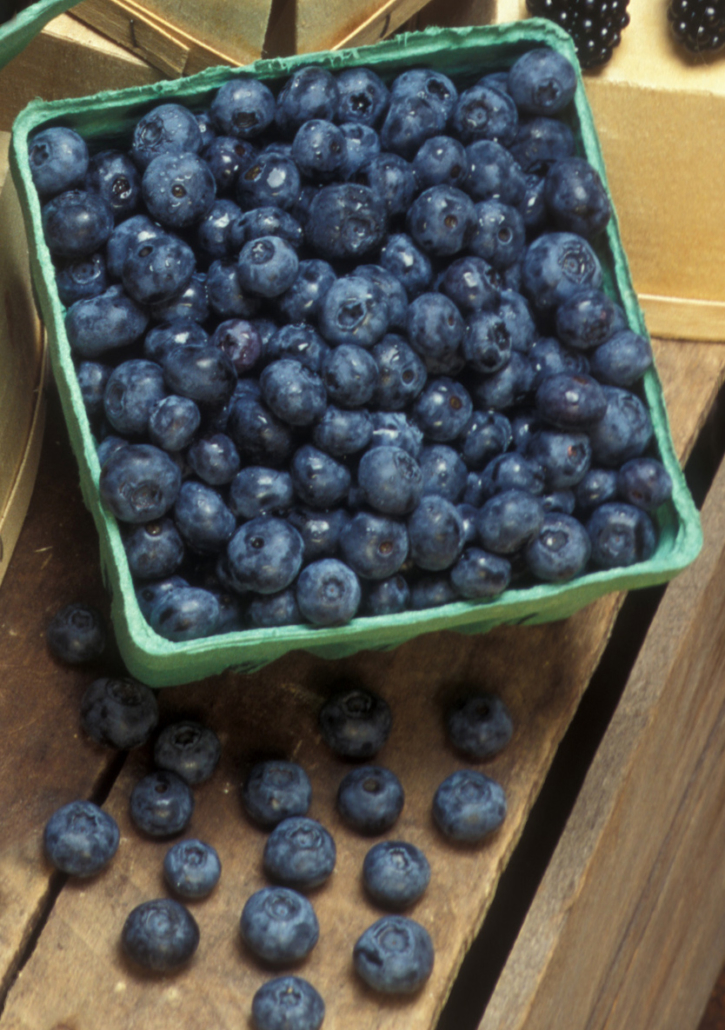
Blueberry: Respect Both Kinds of Roots
 Print This Post
By Guy K. Ames, NCAT Horticulture Specialist
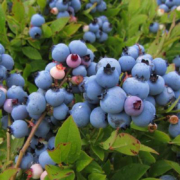
I know of no fruit-bearing bush or tree killed with greater frequency by home gardeners than blueberry plants. I’ve been a fruit-plant nurseryman for over 40 years, and my customers asked so often for free replacements for their dead blueberry plants that we just stopped carrying them in our nursery. Why? What is it about the blueberry that renders it so tender in the hands of so many home gardeners?
The answer is related to its evolution. The blueberry is a swamp thing. Other than its close kin the cranberry, there is not another domesticated fruit plant like it. As a marsh or swamp plant, the native blueberry evolved in acidic, moist soils. Because the blueberry plant did not need root hairs in such a wet environment, it never evolved root hairs. The coarse, fibrous roots of the blueberry plant do some of the work of taking up water and nutrients, but their main jobs are anchorage and carbohydrate storage.
Most of the water and nutrient uptake is performed by blueberry-specific “mycorrhizae” (literally “fungal root”), in a mutually beneficial relationship with the blueberry plant. The actual blueberry roots rarely extend much beyond three feet from the crown or soil surface. However, where the actual roots of the blueberry end, the mycorrhizae keep going. The mycorrhizae specific to blueberries are endophytic (literally “inside the plant”) and are anchored in the blueberry root but extend their hyphae (very thin hair-like filaments) well beyond the actual root into the surrounding soil effectively multiplying the plant’s rhizosphere (root zone) many times over. In this elegant relationship, the blueberry shares the sugars it gets from photosynthesis with the mycorrhizae, while the mycorrhizae share water and soil nutrients with the blueberry. It’s a win-win!
So, growers need to understand that they are really growing two organisms: the blueberry plant and its mycorrhizae. Growers, then, must provide regular and abundant water as well as maintain conditions favorable to the mutualistic fungal mycorrhizae. Besides lots of water, the grower will need to maintain a low pH (acidic) in a high organic matter soil and not disturb that soil with cultivation, all factors necessary to preserve the mycorrhizae.
Interestingly, a commercially significant root disease incited by the fungal pathogen Phytophthora cinnamomi, is favored by standing water. Knowing that the blueberry is a water lover, this at first might seem paradoxical, but it’s the standing, stagnant water that is the problem. Where there is water circulation or regular pulses of wet/dry periods, the pathogen can’t get established and is not a problem. It turns out there is more water circulation in a marsh than might at first be apparent. The upshot of this for the aspiring grower is that blueberries are at their healthiest and most productive on raised beds of sandy loam (or similarly well-drained) soil with nearly constant drip irrigation. In the early days of the Arkansas and Missouri Ozarks blueberry industry, phytophthora root rot was rampant and afflicted plants were often easy to find simply by visually following plant rows across a hilly site: the disease was often limited to where the row dipped into a low spot and plants on nearby higher ground might be completely unaffected.
Commercial growers have had to understand the nature of the highbush blueberry, as they won’t long stay in business if they don’t maintain a low soil pH and, most importantly, provide regular drip irrigation. Without that regular and steady irrigation, the blueberry plant will die of thirst. Rare is the gardener who believes that they would let a plant die for lack of water, but the blueberry is not just any plant. However green-thumbed a gardener may be, the first time they go for a summer vacation, and they haven’t installed an automatic irrigation system, they shouldn’t be surprised to see upon their return their adopted swamp thing dying for lack of water.
Related ATTRA Resources:
Blueberries: Organic Production
Tree Fruits: Organic Production Overview
This blog is produced by the National Center for Appropriate Technology through the ATTRA Sustainable Agriculture program, under a cooperative agreement with USDA Rural Development. ATTRA.NCAT.ORG.
 wikicommons Zeynel Cebeci
 Wikimedia


 Julian Fong Wiki Commons