Multispecies Grazing: Farmer and Rancher Stories
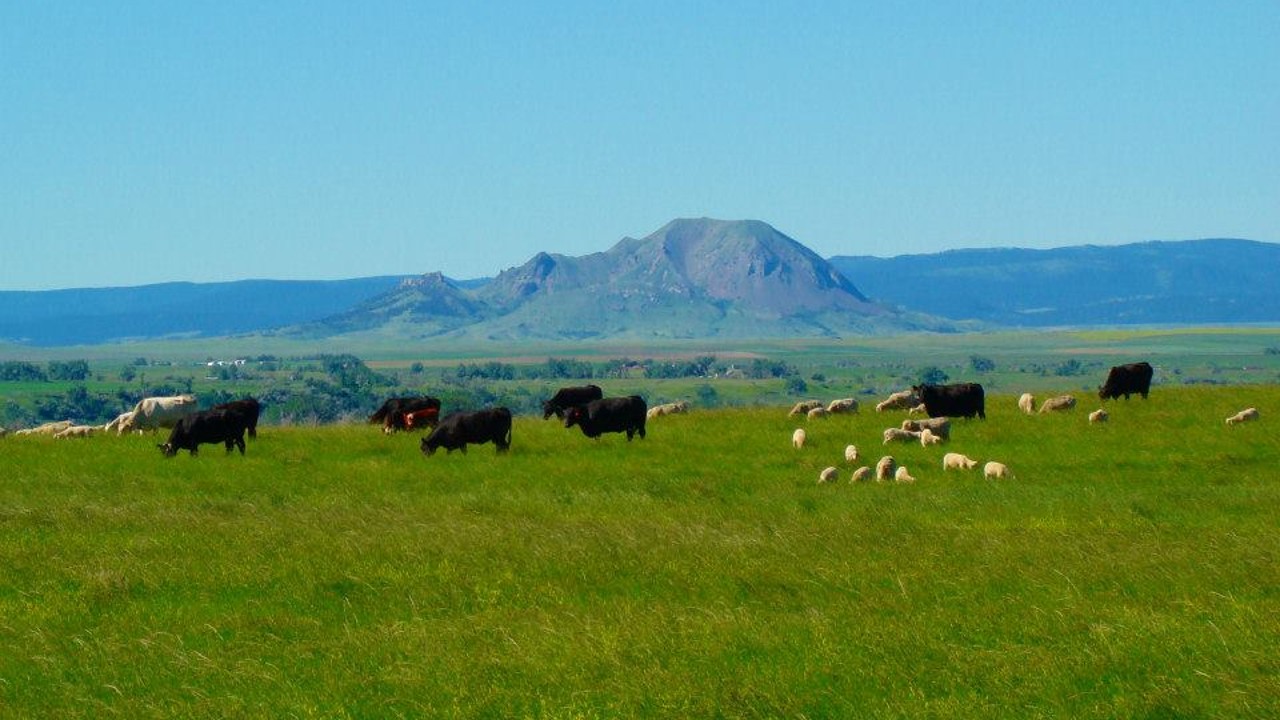
Photo: Dave Ollila
By Danielle Duni and Lee Rinehart, NCAT Agriculture Specialists
Abstract
This publication recounts the experiences of four ranchers situated in both the eastern and western United States who use multispecies grazing to manage their landscapes and increase profitability. It provides an account of their experiences, what they’ve learned, and why they decided to graze multiple species of livestock on the same land. The reader will learn how these ranchers manage rangelands, how they build local food systems, and how they have renovated low productivity soils by increasing the percentage of organic matter by grazing animals. Finally, we cover the mechanisms and processes of grazing different species of animals together from a rancher perspective.
Contents
Introduction
Dave Ollila, South Dakota
Wilder Jones, Idaho
Suzanne and Hubert Karreman, North Carolina
Greg Brann, Kentucky
Conclusion
Reference
Further Resources
Introduction
Multispecies grazing is one of the most powerful ways producers can diversify their farms. Among its benefits are an increase in carrying capacity, ecological resiliency, pasture health, better vegetation management, parasite control, and protection from predators.
All this can happen while providing an increase in and/or more consistent income. This publication highlights the experiences of four livestock producers, representing ranches in the eastern and western United States. It is a companion piece to the ATTRA publication Multispecies Grazing: A Primer on Diversity, which goes into more detail on the practices and techniques, with practical tips and ideas for managing multiple species on grazing lands.
The experiences of the ranchers featured in this publication show a consistent theme. They all recognize the importance of maintaining an operation that is manageable in scale and complexity. Whether addressing labor availability, herd/flock size and species composition, grazing plans, or water and fencing requirements, these innovative producers emphasize that management strategies should be designed not only to be effective but also to remain feasible over time. Once a practice is implemented and demonstrates positive results, its long-term sustainability becomes essential.
Low-Input, Practical Co-Grazing of Cattle and Sheep for Sustainable Range Management
Dave Ollila, South Dakota
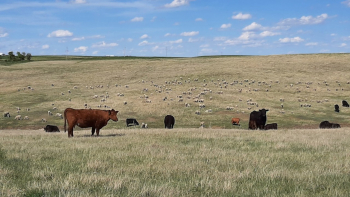
Photo: Dave Ollila
The Ollila family has run sheep and cattle for multiple generations on western South Dakota’s shortgrass prairie. Dave Ollila manages approximately 200 animal units, integrating cattle and sheep on range that gets 15 inches of annual rainfall. They also harvest supplemental forage from 300 acres of irrigated hay ground. Sheep have always been integral to the operation, both culturally and economically. They chose Rambouillet sheep specifically because, as Dave puts it, “Rambouillet sheep fit into this semi-arid environment because there are limited water resources.” For the Ollilas, running two species has provided income stability and helped fully utilize the landscape. The old adage applies in his area of “one ewe and her lamb, following behind one cow and her calf.” The plant diversity and grazing habits vary enough between the species that there is little competition for the same forage.
The ranch consists of rangeland with 80% grasses and 20% broadleaf plants, alongside irrigated ground in hay, alfalfa, and seasonal cover crops. The sheep work well for the Ollilas because of the highly marketable value of their wool fiber. Their environment produces exceptionally clean wool because the sheep spend limited time in pens and receive a high plane of nutrition from diverse forage. Seasonal alfalfa and crested wheatgrass pastures (70:30 mix) provide spring grazing, while upland prairie offers the resilient, drought-tolerant forages characteristic of the region.
Sheep have always been a part of the operation, complementing cattle grazing patterns and allowing better use of the prairie. Sheep target sweet clover blooms and other broadleaf plants, opening the canopy and improving grass growth. Dave firmly believes that without sheep, “Grazing opportunities are missed due to the differences in anatomy of sheep and cattle when grazing.” Running both species helps maintain plant diversity, strengthens economic resiliency, and enhances the overall function of the ecosystem.
The Ollilas practice mob grazing, running sheep and cattle together. Lambing occurs in late March and early April. Shed lambing allows for close care and high survival, such that they average 170% to 180% lamb crop at turn out. Calving follows in late April and early May. As cows calve, they are moved out to green grass with sheep pairs. From there, cows and ewes with offspring move into weekly 20- to 30-acre rotations emphasizing the “three R’s” of rotation, rest, and recovery. This timing supports balanced grazing pressure and ensures fresh forage.
A unique feature of the operation is the use of “flerds” of bonded groups of sheep and cattle. They create these through temporary confinement, allowing the two species to smell each other across the fence from a young age before commingling the flock and herd. This management strategy limits any potential issues by letting livestock become accustomed to one another, which allows for cohesive multispecies grazing.
Fencing strategies vary seasonally. For lamb-weaning and tighter grazing areas, Dave uses 5- to 10-acre woven wire enclosures. For summer grazing, he uses electrified high-tensile wires set at 35 inches and 18 inches, with a third training wire added below temporarily for lambs. Perimeter fencing of four and five wires allows flexible use of internal temporary systems. Generally, the livestock do not attempt to escape their paddocks because they are moved before feed runs low.
Providing livestock water to accommodate both species is the major challenge. Stock dams (also known as dirt or earthen dams) can be dangerous if water recedes quickly, exposing mud that can cause “mud bogging,” where lambs and ewes become stuck. Lambs can also drown if they have to drink out of a cattle tank. To solve sheep access issues, in some areas Dave uses a three-quarter-buried 3.5-foot tank with an 18-inch internal cage that allows lambs to stand safely while drinking. Adequate snow can supplement winter sheep hydration, taking the pressure off providing proper water sources for part of the year.
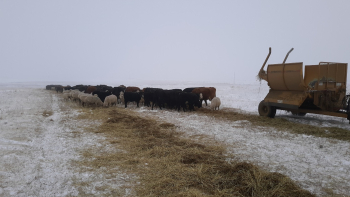
Winter feeding with rolled out bales. Photo Dave Ollila
Sheep and cattle overwinter together, sharing a single set of shelters, which allows for one set of chores and feeding. The Ollilas use a carefully layered feed ration to reduce waste, with a mix of grain hays, alfalfa, grass hay, millet, and sorghum sudangrass. The bales are fed in a sequenced fashion, first unrolling the sorghum, then grain hay, then alfalfa hay. The bale processor is set to a short cut to allow the calves and sheep access to the feed. Cofeeding reduces waste as the cows eat the larger feedstuffs and the sheep clean up the finer material such as the alfalfa leaves, resulting in higher overall utilization and nutritional benefit across the flerd.
The operation does not have livestock guardian dogs due to strong concentration of people in the area. Instead, they use guard llamas and donkeys within the flerds. The cattle presence deters coyotes, though eagle predation remains an issue with the sheep.
Dave Ollila’s goals include maintaining ecological health, maximizing forage diversity, and sustaining financial resilience. Sheep, a two-crop animal with income streams from both wool and meat, offer a consistent 2% return and stabilize the ranch’s “peaks and valleys” in income. Long term, they value keeping the operation simple and generationally accessible.
Ollila emphasizes the need for low input, practical systems and consistent production. “However you run your operation, keep things easy enough that a teenager can do it.” He encourages others to consider integrating sheep through targeted grazing as to not miss forage opportunities, even if this involves grazing the neighbors’ livestock. Dave’s broader philosophy focuses on maintaining the native condition of the rangelands, minimizing the disturbance, ensuring plants have living roots, and keeping livestock present on the land.
For more information, Dave Ollila can be found across several platforms and partner organizations. His contributions appear in Working Cows, the World Wildlife Fund, NRCS’s Our Amazing Grasslands series, and the South Dakota Soil Health Coalition. He is also a regular presenter for the South Dakota Master Lamb Program.
Exploring the Potential of Biological Systems to Produce Nutrient Dense Food
Wilder Jones, Wild Spaces Farm, Idaho
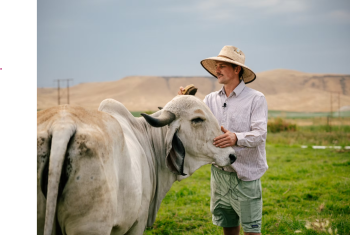
Wilder Jones. Photo: Ross Perkins
Wild Spaces Farm is located along the Snake River in southern Idaho at an elevation of roughly 2,400 feet. This diversified operation is owned and operated by Wilder Jones, who returned to his family’s farm nine years ago. The farm was historically operated by his father, Nate Jones, one of Idaho’s pioneers in certified organic farming in the 1990s. The farm is 160 acres of flood-irrigated pasture. The soils are predominantly silty loam, with high alkalinity, influenced by the ancient Lake Idaho geological formation. The forage base is a mix of fescue, alfalfa, orchard grass, white clover, intermediate wheatgrass, saltgrass, plantain, chicory, and various improved pasture mixes. Wilder sees all life on the farm as an opportunity, even down to the presence of weeds. He is known for saying, “needs, not weeds” and challenges the assumption that volunteer plant life signals disorder. Instead, Wilder views the landscape as a responsive ecosystem, where plants and animals emerge for a reason and are perceived as an opportunity.
Wilder Jones describes inheriting a “blank canvas” when he moved back home. Although he was raised on the farm, he was never pushed into agriculture. He returned with fresh interest in food systems, rangeland ecology, and permaculture. Between seasons of farming, Wilder completed a degree in natural resource conservation, bringing home new ideas each season. In 2021, Wild Spaces Farm’s journey into multispecies management began with a small-scale, grass-based, specialty breed dairy cow enterprise. Rather than adopting confinement systems or strict milking schedules, Wilder experimented with a model rooted in land health and animal wellbeing.
With a smaller dairy herd, he quickly observed the extent of forage abundance that had been underutilized by larger groups of range cattle. With different pasture management, fields that once seemed insufficient for mature beef cows provided extended grazing periods for the dairy cows, sometimes delivering 40 days of feed due to their smaller number and different grazing behavior. Wilder used intensive rotational management when possible, but he stressed that long-term success requires recognizing personal limits. Grazing systems, he noted, should match both ecological conditions and the operator’s capacity in order to avoid burnout.
In 2024, a small flock of hair sheep joined the dairy cows, pasture-raised hogs, and laying hens. Each species plays a distinct role. Sheep serve as effective browsers, utilizing forbs and regrowth that cattle leave behind (cattle are first to enter a pasture) improving overall pasture uniformity. Pigs follow the sheep, disturbing the soil significantly. Although the impact may appear excessive initially, with proper rest the affected areas consistently recover and show improved moisture retention, vigorous grass regrowth, and volunteer annuals whose seeds from their organic feed rations survive the journey through the pigs’ digestive systems. Chickens complete the sequence by scratching through manure, targeting larvae, and aiding in nutrient cycling of the remaining plant residue.
Although Wilder Jones likes to be dynamic and flexible in his management, not subscribing to specific grazing strategies, his approach is similar to leader-follower that mimics a classic multispecies grazing system, which he adapts to his own labor constraints. Some seasons, he moves animals daily. In others, he moves them at two-week intervals. When the sequence aligns (cows are introduced to a paddock, followed by sheep, pigs, then chickens), a balance occurs that Wilder calls a “symphony.”
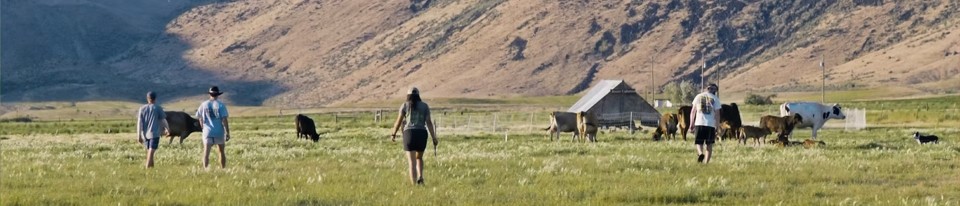
Photo: Ross Perkins
Grounded in ecological principles, Wild Spaces Farm prioritizes rest periods based on animal health and forage recovery. Cattle pastures require a minimum of 30 days of rest before reentering a paddock to avoid the risk of parasites from grazing near fresh manure. Sheep move behind the cattle and remain in a pasture for four days or less to prevent exposure to parasites. Pigs remain in a paddock no longer than seven days, after which the area receives a full season of rest to recover from their concentrated disturbance. Jones typically moves chickens on a weekly schedule, though he makes adjustments as needed according to manure load and pasture conditions.
Dairy cattle are fenced with single strand of polywire. Due to the requirement of consistent shelter, water and mineral access, and milking intervals, dairy cattle’s rotations are designed to flow back to a central barn via alleyways.
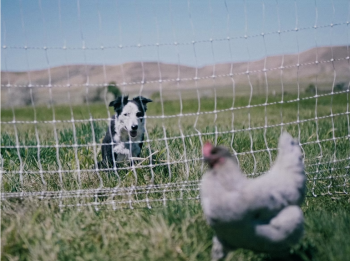
Zia the Border Collie. Photo: Ross Perkins
Chickens are housed in a mobile laying coop and secured with electric netting. The sheep, protected by Moose, the livestock guardian donkey, are also contained with electric netting, which can be moved easily by one person with the assistance of Zia the Border Collie. Despite having only a half-mile stretch from farm center to the northern boundary, Jones remains cautious about placing sheep too far from home without observation. He also keeps the chickens closer, as moving coops and netting long distances is labor intensive. Grazing rotations are dictated by access to shelter, mineral, and water, as well as the equally critical factor of ensuring adequate forage availability.
Wilder Jones’s goal for Wild Spaces Farm is to provide nutrient-dense food to his local community and bioregion, while living a fulfilling life rooted in land stewardship, animal husbandry, and ecological abundance. The inhabitants of the farm view it as a place to explore the inherent potential of biological systems and to
share the abundance with family, friends, and neighbors.
For more information about the operation, visit facebook.com/wildspacesfarm. To learn more about the family’s original enterprise and the foundation on which this work was built, explore King Crown Organics.
From Parking Lot to Pasture with Multispecies Grazing and Mulch
Suzanne and Hubert Karreman, Reverence Farms, North Carolina
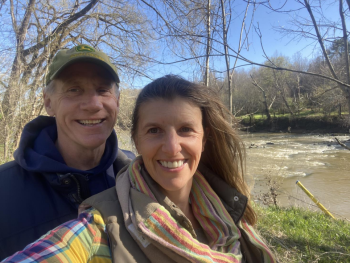
Photo: Hue and Suzanne Karreman
When Suzanne and Hue started farming the red soil of their North Carolina land, her goal was to be able to eat two things she couldn’t find in grocery stores: Eggs from birds raised outside in the sun and milk from a cow that ate forage. It took them 18 years to build a sustainable farm infrastructure. They accomplished this (and Suzanne would likely tell you it’s still a work in progress) by breeding cows with non-industrial genetics and waking up the neglected Piedmont red clay soil.
“It takes a lot of faith to dairy here,” says Suzanne, who gave her multispecies grazing system a (relative) break to focus on building the soil. At the time, she was raising 5,000 chickens and 150 pigs a year, but the unproductive pastures struggled to support them. That’s when she decided to switch gears. She downsized the animal numbers and put her energy into increasing and enriching the life in the soil. The forages she needed to support the high nutritional demand of a milking herd were not happening on the red clay soils with 0.45% organic matter (OM). From that moment on, the animals became a part of her soil building strategy.
“We went from a completely stripped forest soil of 0.45% OM to 6% OM in five years,” noted Suzanne. Animals were a crucial part of the process, but she needed more organic matter than she was getting with animals alone. Even cover crops were not enough; the first plantings were stunted and yielded little biomass. So, in addition to the cover crops, she imported a massive amount of feed and dairy-quality hay and fed the dairy cattle, chickens, and some pigs they borrowed from a neighbor right on the parking-lot-like pasture. “We fed on it until it obeyed!” said Suzanne of their pasture renovation system.
The Karremans also dosed the Piedmont Georgeville silt loam soil with fish emulsion and truckloads of carbon. In addition to spreading material from the bedded pack barn, she developed relationships with local businesses to bring in powerline tree and shrub clippings by the truckload. In fact, Suzanne explained that developing neighborly relations is key to the success of a sustainable farm. She began bringing the clippings in, paying only for the shipping, but soon the drivers were bringing more loads than initially agreed upon. It was a win-win situation for them, as Suzanne got tons of organic matter and the tree company got a place to dump excess clippings. In addition to bale grazing (especially over weeds), they applied stale hay, straw, and old mulch—any carbon source she could get from her farm or from neighboring land through bartering.
Then, the borrowed pigs went to work. Suzanne adapted a feeding system where she fed the pigs based on animal numbers in a single paddock. While mainly a soil renovation system, the pigs did receive high nutrition, outdoor access, and the fellowship of their companions—everything a pig really wants in life. She provided one ton of feed for groups of 25 to 50 pigs on one-half acre paddocks and adjusted the amount of feed for smaller groups. If she was only feeding 10 to 15 pigs, she would cut the paddock size in half and provide one-half ton of feed.
Suzanne developed the system so that when the feed was gone, it was time to move the animals. The formula she uses holds no matter how many animals are being fed, how big they are, or how long they stay on the pasture. Suzanne was after the impact the animals would have on the soil–rooting, disturbing, and incorporating manure, urine, and spent feed. Anyone who has seen the aftereffects of well-managed pig grazing will know this tactic can yield incredible results, as indicated by the accompanying before and after photos of Suzanne’s pastures.
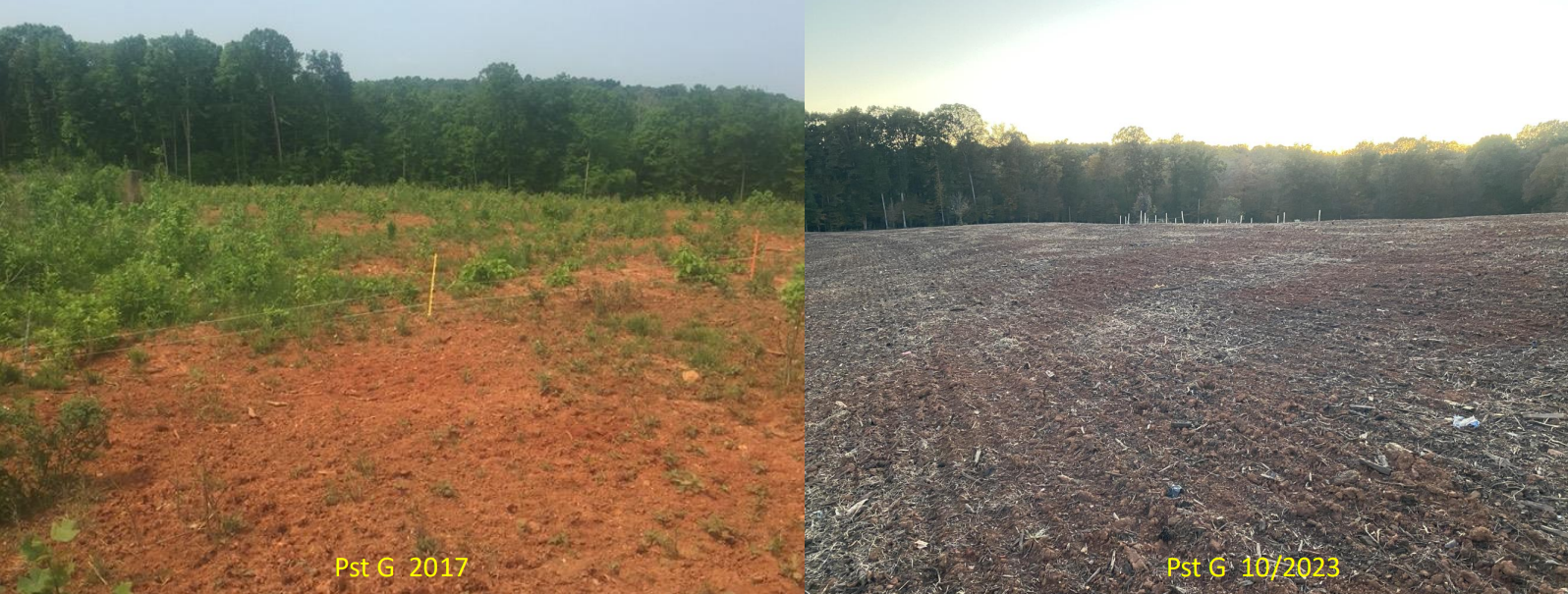
Karreman paddocks before and after animal impact and additions of organic matter. Photo Hue and Suzanne Karreman
That being said, Suzanne advises pigs be moved when the soil becomes muddy. Animals on muddy soil usually lead to soil compaction, and this could negate the effects of your efforts at increasing pasture productivity. Once you move the pigs off the site, it’s best to rest the area until the plants have fully recovered. Look for seedheads on the grasses. It could take months or even a year for the site to fully recover, but once it does, or when annuals become well established, the site is ready for sheep and cattle to graze.
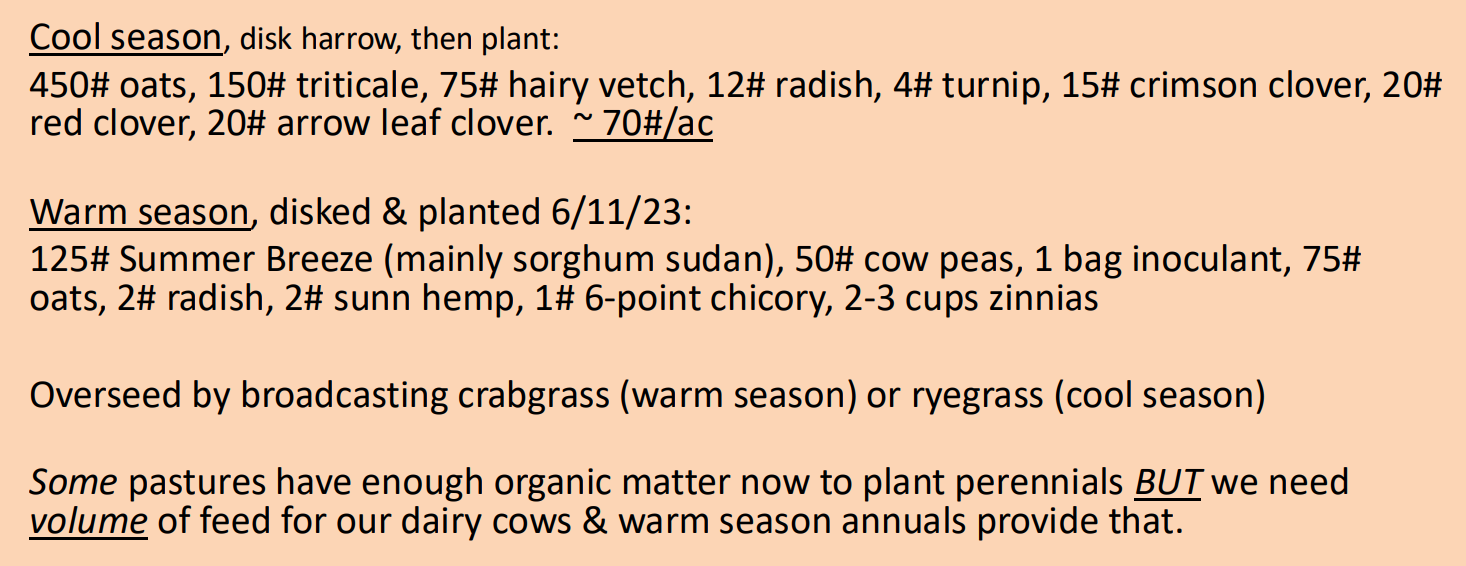
Graphic 1: Pasture seed mixes
Credit: Hue and Suzanne Karreman
Speaking of annuals, other producers have asked Suzanne why she doesn’t plant perennial pastures. After all, annual crops require tillage and energy while perennials, especially cool season perennials, can supply high quality dairy feed while building soil resilience. Her soils could not support perennial production, and there was an immediate need for high quality forages. The annual crops she uses, such as clovers, ryegrass, and brassicas, are rocket fuel for growing and lactating animals.
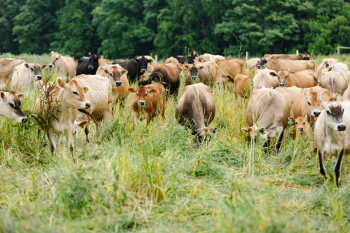
Dairy cows on high quality renovated pasture, Photo Hue and Suzanne Karreman
Currently, Suzanne and Hubert milk a 60-cow herd of A2A2 (cows with the A2A2 gene produce only A2 milk, which has been claimed to have better digestibility), polled, grazing Jerseys, with the calves raised with their mothers, and direct market pork and lamb from resilient, high-quality pastures.
They are still grazing annual crops with the hope of someday planting perennials, but until then they are focused on soil improvement. In the last five years, their pasture soils have gone from less than one percent organic matter and a pH of 5 to over six percent organic matter and a pH of 6.6, all because of multispecies grazing, massive amounts of carbon, and attention to soil improvement.
Farming is a long-term activity and lifeway. The Karremans would say they are still investing more than extracting and so have two other businesses for cash flow. They mentor farmers through their Stockholders Exchange, have a natural dairy product line, and operate a program called Cowmaster to support commercial dairies on nutrition and health. You can see more about their operation and their products at Reverence Farms.
The Mechanics of Multispecies Grazing
Greg Brann, Big Spring Farm, Kentucky
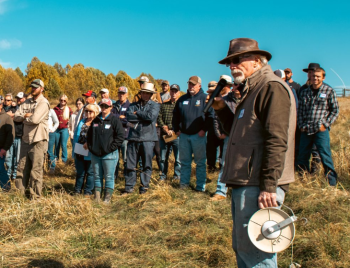
Photo Greg Brann
Greg Brann and his brother Dale raise livestock on land their father William acquired in 1963. William raised cattle on the land, and in 2000 Greg and his brother Dale began rebuilding the perimeter fence, this time designing it for multispecies livestock. They introduced Kiko goats into their cattle herd and built a goat corral with welded-wire panels and steel posts. Their first attempt was to graze the goats on lush bottomland grass—a decision that proved to be a mistake. Greg remembers the growing pains: grazing lush wet grass led to foot problems and meningeal worms killing some does (also known as nannies). They moved goat kids to shelter, but that confused the mothers, leading to some abandonment of kids. They fed alfalfa hay but left it out in the rain, which caused bad fermentation and led to listeriosis. Family members left the goat operation and returned to running cattle, but Greg persisted. He eventually got the problems under control and grew the herd of goats to 300 does. In 2004, Greg added Katahdin sheep to the mix and now runs 250 cattle and 200 small ruminants.
Why would a cattle producer take on the challenge of managing the disparate needs of several livestock species at once? For Greg, running multiple livestock species allows him to match animals to the vegetation best suited for them. “I would keep some small ruminants even if I didn’t sell them,” Greg reflects. In return for his investment, he is rewarded with better weed control and improved nutrient cycling. “Small ruminants increase manure distribution in the pastures and reduce spot grazing, since sheep will graze right up to cattle manure.”
Greg increased his stocking rate by 20% by adding sheep and goats to cattle. However, the primary consideration for adding different species is a good perimeter fence. If the fence keeps the goats in, it will keep any species in. Then it’s just a matter of dividing interior paddocks with polywire and ensuring all species are trained to the electric fence. Greg recommends a high-voltage charger (at least 3500 volts) and training animals to the wire by penning them with a highly charged wire at nose height for a week so they can learn to respect the electric fencing.
Greg recommends a tight perimeter fence of four to six wires, with the bottom wire eight to ten inches off the ground and the top wire 32 inches or more off the ground for cattle, sheep, and goats. He then uses polywire on step-in posts 40 feet apart for all species in the inner paddocks. Again, Greg has found that polywire works well for all species if they have been trained to it.
Greg maintains a low ratio of sheep to cattle and relies on a single wire, typically moving cattle daily to apply a stock density of around 30,000 pounds of live weight per acre on 3-acre paddocks. Cows, sheep, and goats graze together in the paddocks. After years of experience, he has determined that, on his landscape, one ewe or doe per cow is the stocking rate sweet spot. Mature ewes and does use the same ball waterer used for cattle, as well as Rubbermaid 50-gallon tubs with Jobe Mega Flow high-flow float valves and a hotwire across the top. A 1½ horsepower pump pushes well water up a 200-foot elevation through a 1½ inch buried pipe with quick-connect couplers spaced every 400 feet to serve several paddocks, and Greg sometimes allows the animals to back-graze up to four days to water. He rotates the cattle daily with a single hot wire, while sheep and goats are allowed to graze the entire field.
Greg’s approach is to graze pastures high, leaving a post-grazing residue of more than five inches. However, tall grass can make it easier for coyotes to approach sheep unseen, sometimes resulting in lost lambs. For protection, he can move sheep into smaller paddocks near the house, where he and the dogs can keep a close watch. He stocks livestock guardian dogs at a ratio of one dog per 50 small ruminants, using self-feeders for the dogs. Greg recommends choosing a dog that will stay with the sheep, preferring short-haired breeds like Anatolian Shepherds, Akbash, or Maremma crosses with Pyrenees.
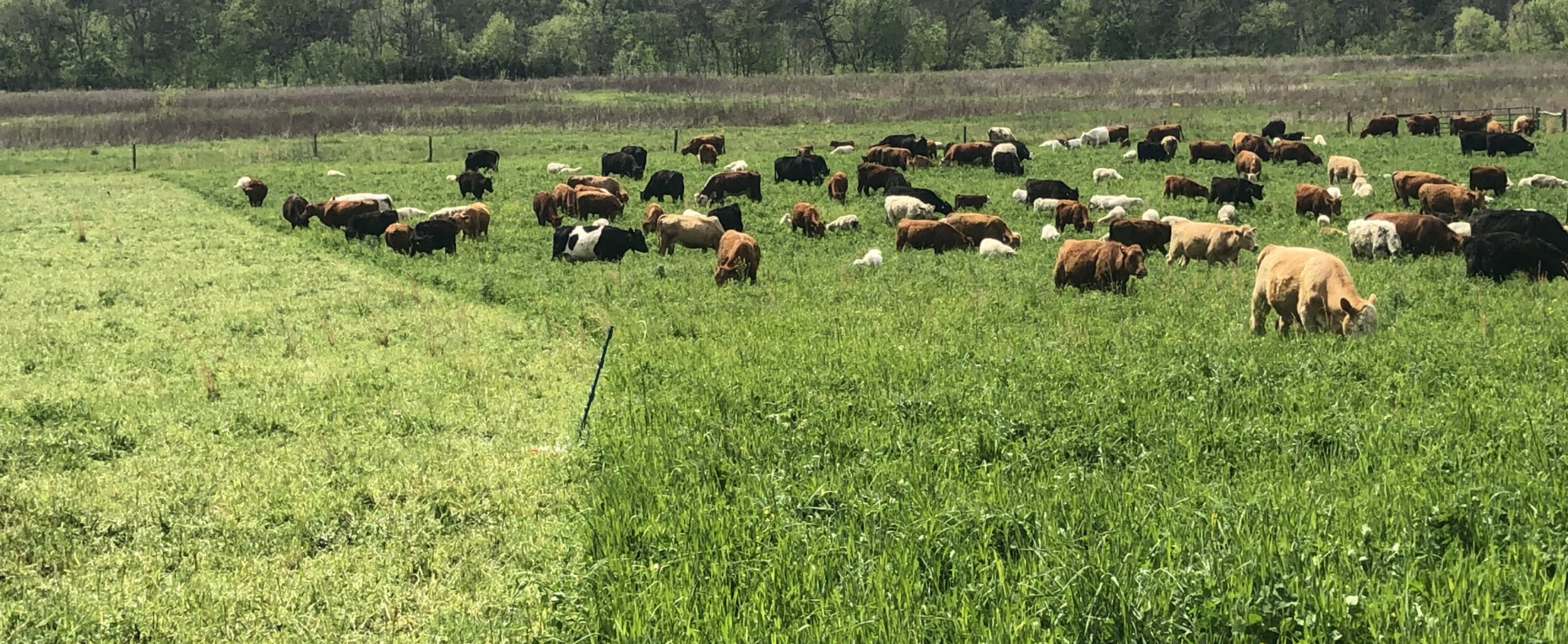
Grazing a low ratio of sheep to cattle with a single wire to divide paddocks. Photo Greg Brann
As mentioned, despite their lower numbers compared to cattle, small ruminants have a place in Greg’s landscape management program as they fill an ecological niche. He maintains their well-being by selecting sheep and goats with good feet, erect tails on goats, and good health. He uses FAMACHA©, culling, maintaining proper grazing heights, and adequate mineral supplementation to support the animals’ immune systems. Since predators are the biggest threat, Greg isolates lambs and kids in pens near his home where they can be better protected.
As with many multispecies graziers, fencing and managing dogs are some of Greg’s biggest challenges. But, Greg says, “Sheep are super easy if you have a low stocking rate. And separating them from cattle is fairly easy; they usually separate themselves.” When gathering animals, he uses a high wire in the paddock or pen to keep cattle back, giving the sheep time to mostly sort themselves.
Brann’s “organized chaos” in action. Photo Greg Brann
Grazing multiple species of livestock on Big Spring Farm is “organized chaos,” and an example of biomimicry in action. This is why he grazes all species together instead of separately and sequentially. In a rotational grazing system, animals must be moved when they have grazed the forage to a certain height. But cattle and sheep graze differently, and one group may be ready to move to the next paddock while another is not. Grazing one herd simplifies the system, and even if he moves animals before the grass has been grazed to the optimum height, “it’s easier to graze second growth” later if you move off a paddock early.
Greg’s grazing experience confirms the research. Well-managed multispecies grazing can diversify the plant community, increase carrying capacity, and build soil health and resilience. Anderson et al. (2012) notes that this management practice “may be one of the most biologically and economically viable systems available to producers, especially on landscapes that support heterogeneous plant communities.” Because of his practices, Greg hasn’t fertilized his pastures for 18 years, and his soil nutrients remain in the medium to high testing range. The soil system has stabilized at a pH of around 6.0 to 6.8, and he hasn’t applied lime in 10 years, all because of his grazing management and the manure distribution from his small ruminants. In addition, through high-density grazing, the animals are less selective in their diet and commonly eat forbs such as pigweeds, ragweeds, lambsquarter, ironweed, and several forbs such as multiflora rose, plantains, and lespedeza that contain natural tannins that help with parasite control.
Greg’s philosophy of grazing is focused on managing the whole. Key indicators such as increased pollinators, greater plant diversity that fosters medicinal pastures, lambing in warm weather, and keeping his sheep numbers low contribute to a sustainable, manageable, and profitable system.
For more information on Greg’s operation, including articles on grazing management, field day opportunities, and livestock production sales, visit his website at gregbrann.com.
Conclusion
Multispecies grazing is successful when graziers match livestock to the appropriate landscape and vegetation; when they design fencing and working facilities for the specific animal species; when producers reduce parasites and predation pressure; and when the stocking rate and pasture recovery is well planned and executed. The principles and examples as described in these rancher stories can help those new to grazing multiple species consider the practices they may want to implement on their own operation.
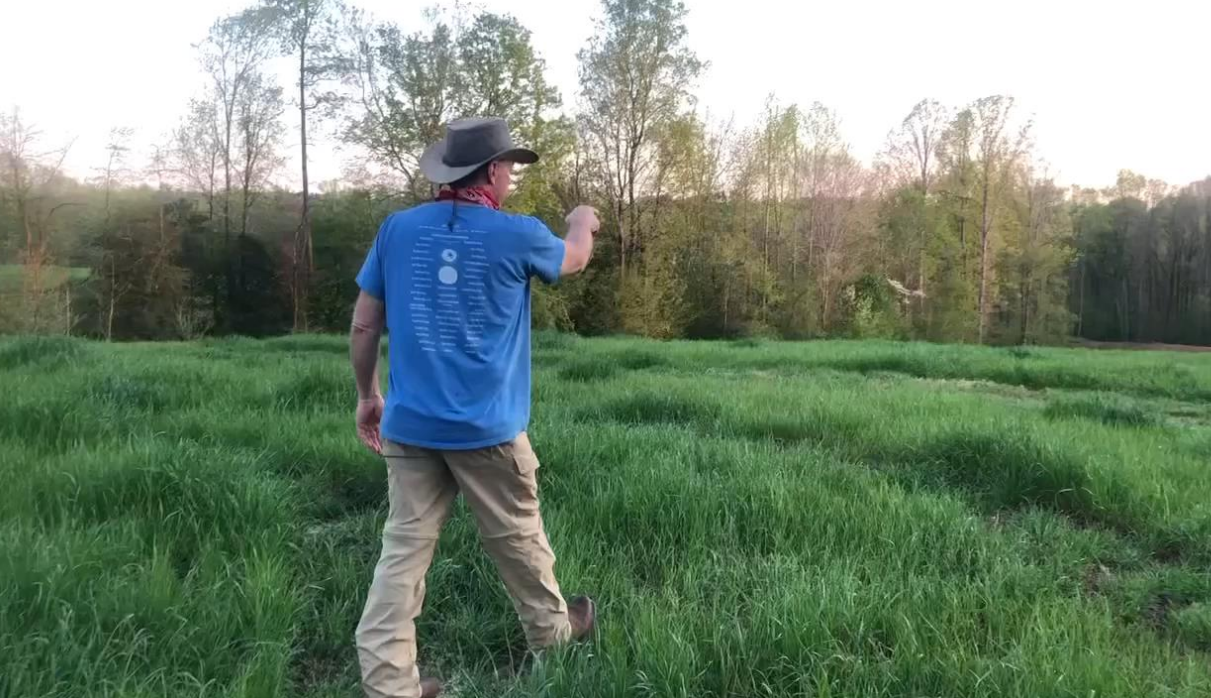
The farmers and ranchers who shared their stories in this publication have used multispecies grazing for many purposes. Healing the land and sharing space with wildlife are common themes among them all. Photo: Hubert Karreman
Reference
Anderson, Dean, E. L. Fredrickson, and Rick Estell. 2012. Managing livestock using animal behavior: Mixed-species stocking and flerds. Animal. Vol. 6, No. 8. p. 1339-1349.
Further Resources
Multispecies Grazing: A Primer on Diversity. By Lee Rinehart. ATTRA Sustainable Agriculture, NCAT, 2018.
This publication discusses the principles and practices of grazing multiple species of livestock on pastures. Here, you’ll find a discourse on the benefits of multispecies grazing on productivity and profitability, including its positive impacts on pasture diversity and health. Also covered are grazing dynamics (how diverse animal species use grazing resources), the types and kinds of fencing and working facilities needed by various animals, and how to deal with predators, mineral supplementation, and parasites. Finally, it covers vegetation management and how to make stocking-rate decisions. References and further resources are included.
The Small Ruminant Toolbox. Created with SARE support by Linda Coffey and Margo Hale, ATTRA Sustainable Agriculture Specialists, 2014.
Sheep and goat enterprises offer diversification opportunities for small and limited-resource farmers. This Small Ruminant Toolbox was developed by NCAT to provide a collection of information for small ruminant producer and educators. The Small Ruminant Toolbox includes many publications, presentations, and other resources that are helpful to small ruminant producers.
Videos
Multi-Species Grazing at Big Spring Farm, Greg Brann, Jul 9, 2018.
Improve Your Farm’s Future with Mixed Species Grazing with Greg Brann, Aug 8, 2024.
Grazing Dairy Cattle: Insights from Hubert and Suzanne Karreman, Ep. 83, Acres USA, The Voice of Eco-Agriculture, Nov 24, 2025.
Multispecies Grazing: Farmer and Rancher Stories
By Danielle Duni and Lee Rinehart, NCAT Agriculture Specialists
April 2026
©NCAT
IP675
Version 040826
 This publication is based upon work that is supported by the National Institute of Food and Agriculture, U.S. Department of Agriculture, under award number 20227042038269 to Sustainable Agriculture Research and Education (SARE). USDA is an equal opportunity employer and service provider. Any opinions, findings, conclusions, or recommendations expressed in this publication are those of the author(s) and do not necessarily reflect the view of the U.S. Department of Agriculture